Logotipo UCM buildingSMART International
  • Nenhum resultado encontrado
  • Casos de uso
  • Espaço de Cocriação
  • Comunidade
    • buildingSMART
      • buildingSMART International
      • buildingSMART Austria
      • buildingSMART Benelux
      • buildingSMART Germany
      • buildingSMART Switzerland
    • Organizações
      • HSLU
    • Parceiros de Colaboração
      • Empresas
      • Associações e Instituições
  • pt
    • en
    • de
    • fr
    • pt
  • Entrar
Localização
buildingSMART Switzerland Andreasstrasse 5 8050 Zurique (Suíça)ucm@buildingsmart.ch
Empresa
InícioSobre nósComunidadeTreinamento
Recursos
Casos de usoEspaço de cocriaçãoNotas de versãoFAQ
Logotipo da buildingSMART
Copyright © 2026 buildingSMART. Todos os direitos reservados.
v5.0.0ContatoDeclaração de Privacidade e CookiesTermos e Condições
Small IconAI Chat

    Circulation Analysis - International

    Comentários

    Carregando comentários...

    AINDA NÃO SE CADASTROU?


    Cadastre-se gratuitamente no serviço Use Case Management para começar a criar seu primeiro caso de uso.


    Usuários cadastrados podem usar a área de download e as funções de comentário.

    Circulation Analysis - International
    Tipo de Documento
    Caso de Uso
    GUID
    4AEFCD1D-706E-4414-9A13-A8E0288CB0A9
    Identificador
    -
    Fase do Ciclo de Vida
    ISO 22263
    Revisão
    V1.1.0
    Status do Projeto
    Aprovado
    Nível de Maturidade
    Exemplo
    Publicado em
    11 de nov. de 2024
    Última Alteração
    11 de nov. de 2024
    Publicador
    buildingSMART International
    Autores
    • Angelika Kneidl
    • Asim Siddiqui
    • Jimmy Abualdenien
    • Peter Lawrence
    • Peter Thompson
    • Rainer Könnecke
    • Timo Lehtoviita
    Início
    Casos de uso
    Circulation Analysis - International

    Caso de Uso Definição do Documento

    Requisitos de Troca

    Ficha Técnica

    Grupo de Projeto

    • Jimmy Abualdenien (Technical University of Munich (TUM))
    • Angelika Kneidl (accu:rate GmbH)
    • Rainer Könnecke (IST GmbH)
    • Peter Lawrence (University of Greenwich)
    • Timo Lehtoviita (LAB University of Applied Sciences)
    • Asim Siddiqui (University of Greenwich)
    • Peter Thompson (Autodesk)

    Copyright

    All documents are licensed as a Creative Commons Attribution-NonCommercial-ShareAlike 4.0 International License
    (Attribution-Non-Commercial-ShareAlike 4.0). Further information can be found at

    creativecommons

    Utilização

    The documents reflect the current best practice and do not claim to be complete. They should not to be understood in the sense of a generally valid recommendation or guideline from a legal point of view. The documents are intended to support appointing and appointed parties in the application of the BIM method. The documents must be adapted to the specific project requirements in each case. The examples listed do not claim to be complete. Its information is based on findings from practical experience and is accordingly to be understood as best practice and not universally applicable. Since we are in a phase in which definitions are only emerging, the publisher cannot guarantee the correctness of individual contents.

    Sumário Executivo

    To plan sustainable buildings with respect to long term maintenance and future development, pedestrian modelling tools can be used in order to check buildings in the early planning phase for their designated usage. These simulations are used to check whether performance indicators are fulfilled and the building is compliant.

    The key data exchanges and interactions between the key stakeholders are captured by the process map.

    Descrição

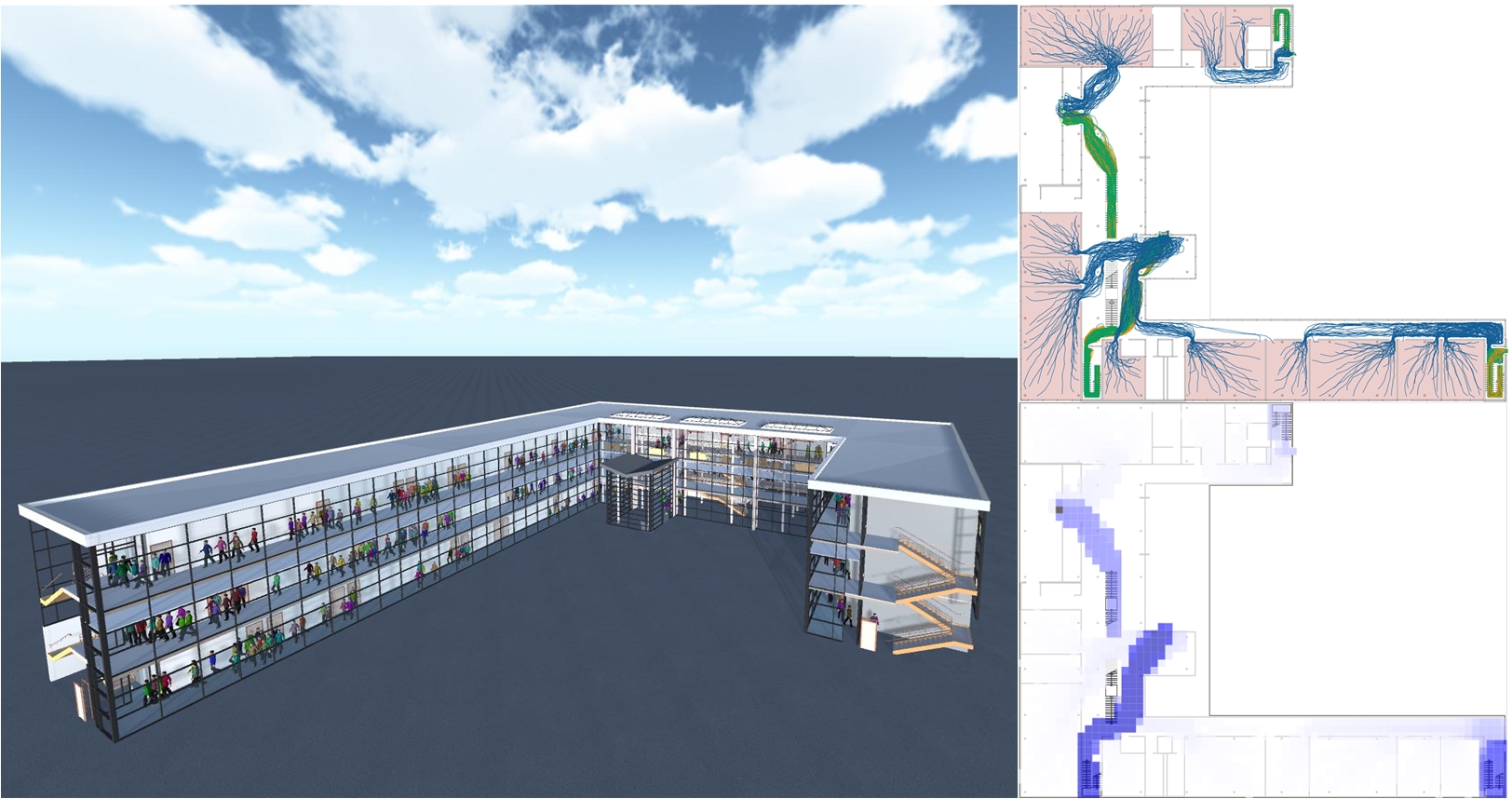
    Conducting circulation analysis (occupant movement analysis under in non-emergency situation) offers a deep insight into the buildings' functionality and allows quick and affordable digital prototyping, avoiding costly planning errors. It is relevant during the planning and lifecycle process of buildings, particularly for complex buildings.
    Desempenho da Entrega

    Input data requirements were captured based on a review of seven representative pedestrian modelling tools and were documented in an Excel spreadsheet. Based on these requirements, an IDS file was created for checking input data requirements. A sample hotel model was then created and used to check the data requirements using the IDS file. These were the key requirements of this use case, which were successfully demonstrated using the sample hotel model through an openBIM based workflow. Furthermore, the following additional work was undertaken and demonstrated:

    • Importing the hotel model IFC file into a representative pedestrian modelling tool (buildingEXODUS),
    • Capturing and adding the key analysis results to the sample hotel model,
    • Checking the sample hotel model IFC file containing output data requirements (i.e. analysis results) with another IDS file specifically developed for this purpose. 

    Fases do Ciclo de Vida

    ISO 22263

    Objetivos e Benefícios do BIM

    The aim of this use case is to achieve an openBIM based workflow for circulation analysis.

    To achieve this aim, the following objectives were identified:

    • Develop a process map for circulation analysis (non country specific)
    • Identify data exchange requirements to carry out circulation analysis using pedestrian modelling tools.
    • Identify current IFC support for data exchange and limitations.
    • Produce a list of data requirements including new property sets and properties.
    • Create an IDS file to check the data requirements.

    Casos de Uso Referenciados

    Abreviações

    OMA - Occupant Movement Analysis

    Descrição

    The input data requirements were specified in an Excel spreadsheet, and then an IDS file was created based on that. The BIM model in IFC format is then checked with the IDS file. Once the IFC file is imported in a pedestrian modelling tool, suitable scenarios are simulated. Results of these simulations are generated which can be shared with the relevant stakeholders. For the output data (i.e. analysis results), the requirements were also specified in an Excel spreadsheet, and then an IDS file was created based on that. The BIM model in IFC format that includes the summary of key analysis results is then checked with the IDS file. 

    Note: To capture simulations results, the following approach was utilised: 

    • The key summary information of the analysis results can be captured using a new property set attached to IfcProject. 
    • The details are included in external files which can be included as links (in a property of the above proposed property set).

    Processo

    Arquivos disponíveis somente para usuários cadastrados. Entre para baixar os arquivos.

    Diagrama de processo

    Processo geral

    Descrição

    Presenting the overall openBIM based process, including the involved actors and the data exchange among them.


    20241030034555_oma-bpmn-circulation-international-openBIM-v3.PNG

    Imagens
    • oma-bpmn-circulation-international-openBIM-v3.PNG (PNG | 198,71 KB) -
    Arquivos
    • oma-bpmn-circulation-international-openBIM-v3.pdf (pdf | 87,34 KB) -
    Evacuation Analysis - International
    Entre para baixar
    Entre para baixar