
- Casos de uso
- Espaço de Cocriação
Comunidade
Organizações
Parceiros de Colaboração

- Entrar


To plan buildings compliant with respect to occupants' safety, a performance-based analysis of the design can be conducted. For that, pedestrian simulations can be utilised. These simulations are used to check whether performance indicators are fulfilled according to regulations and establish if the building is compliant. To perform such analysis the model has to provide specific information such as geometry, population, etc.
The normal practice in relation to fire safety in buildings is to apply a prescriptive approach. However, for more complex buildings, the prescriptive rules are not always applicable. Therefore, a performance-based approach is used, which utilises either hand calculations or computer model simulations to determine evacuation times and possible bottlenecks in the building's design. For a given scenario, performance-based analysis has to determine the Available Safe Egress Time (ASET), which needs to be greater than the Required Safe Egress Time (RSET) plus a suitable safety margin.
Another approach is to use coupled fire and evacuation analysis, where the impact of fire hazards on the population is directly taken into consideration during the evacuation simulation and so RSET and ASET values are not explicitly determined. Although this approach is less common, it can provide more realistic results.
In the ASET and RSET approach, the evacuation analysis is undertaken without exposing the population to the evolving fire atmosphere, and so the fire does not impact the evacuation dynamics in any way. In the coupled approach, the evacuating population are exposed to the developing fire hazards, which may have an impact on their performance or the decisions they make during the evacuation. Using such an analysis, it is possible to derive a more realistic estimation of evacuation times and to determine the impact of the evacuees' cumulative exposure to fire hazards i.e. number of expected fatalities and injury levels [1].
[1] Siddiqui AA, Ewer JA, Lawrence PJ, Galea ER, Frost IR. Building Information Modelling for performance-based Fire Safety Engineering analysis – A strategy for data sharing. J Build Eng. 2021;42(102794). http://dx.doi.org/10.1016/j.jobe.2021.102794
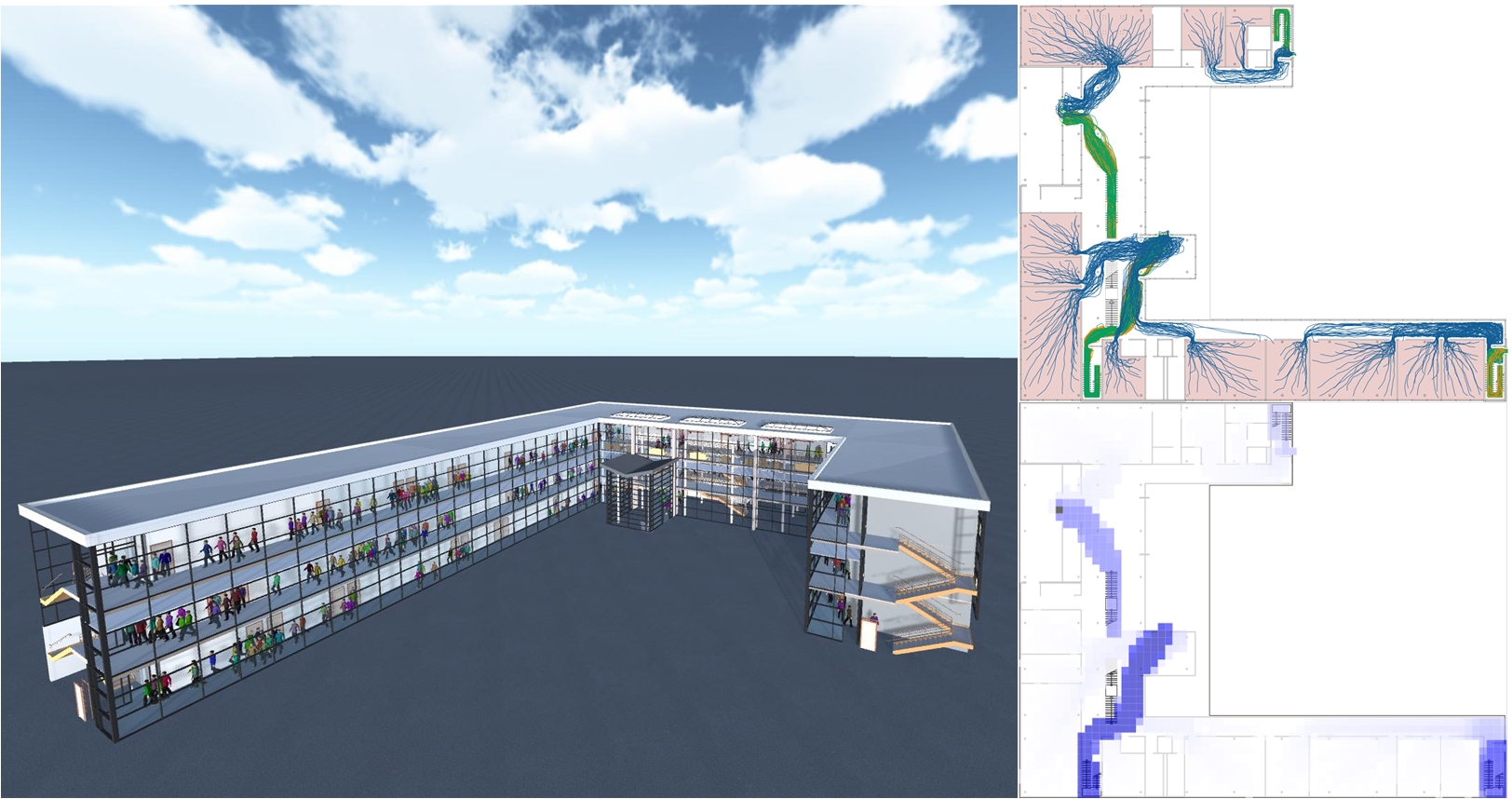
Fire Safety Engineering (FSE)
Occupant Movement Analysis (OMA)
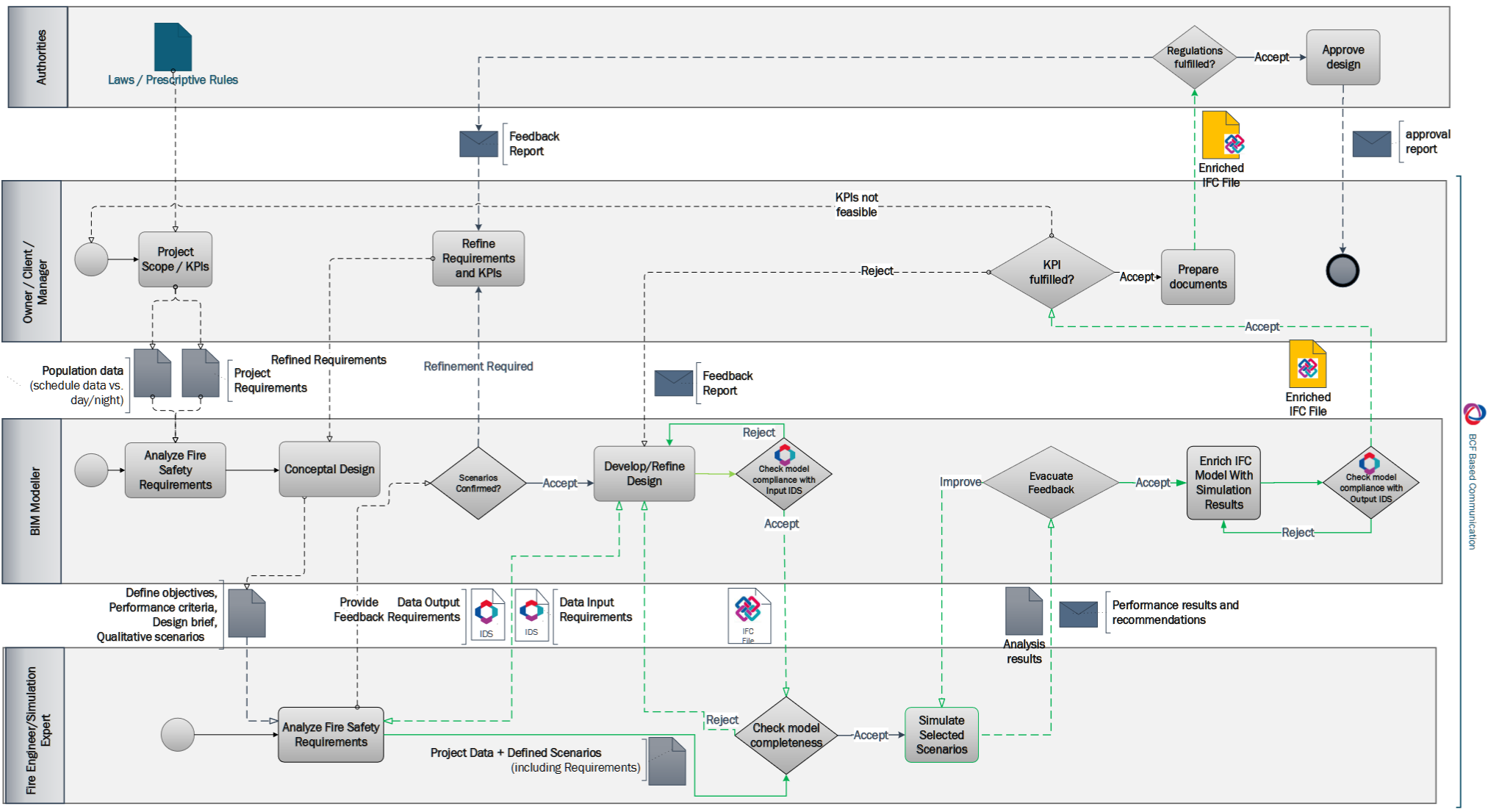
The process map of Evacuation Analysis (International) is shown below:
All dokuments are licensed as a Creative Commons Attribution-NonCommercial-ShareAlike 4.0 International License
(Attribution-Non-Commercial-ShareAlike 4.0). Further information can be found at

The documents reflect the current best practice and do not claim to be complete. They should not to be understood in the sense of a generally valid recommendation or guideline from a legal point of view. The documents are intended to support appointing and appointed parties in the application of the BIM method. The documents must be adapted to the specific project requirements in each case. The examples listed do not claim to be complete. Its information is based on findings from practical experience and is accordingly to be understood as best practice and not universally applicable. Since we are in a phase in which definitions are only emerging, the publisher cannot guarantee the correctness of individual contents.
AINDA NÃO SE CADASTROU?
Cadastre-se gratuitamente no serviço Use Case Management para começar a criar seu primeiro caso de uso.
Usuários cadastrados podem usar a área de download e as funções de comentário.
